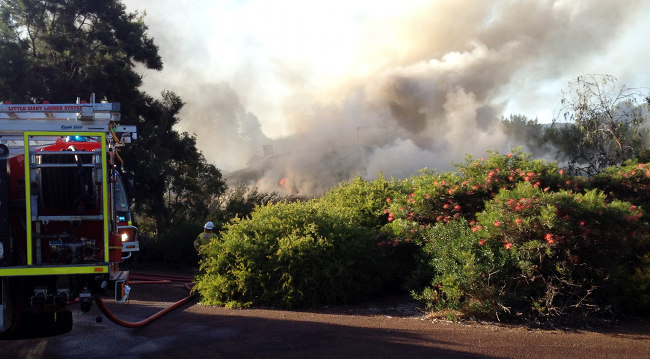
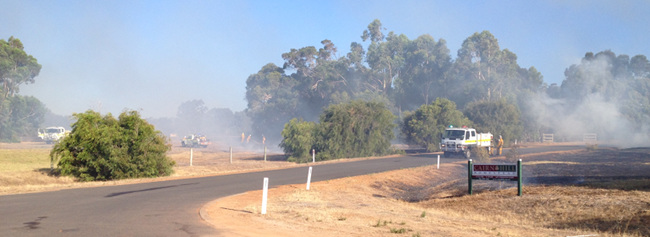
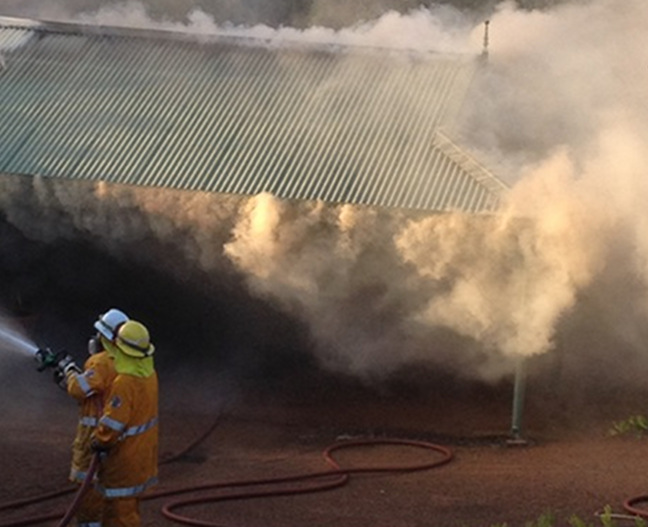
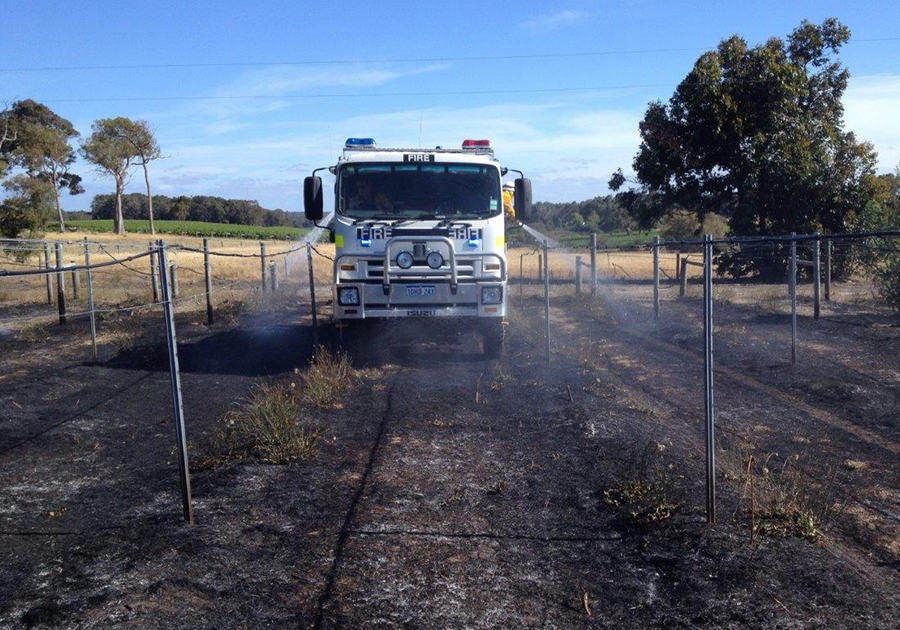
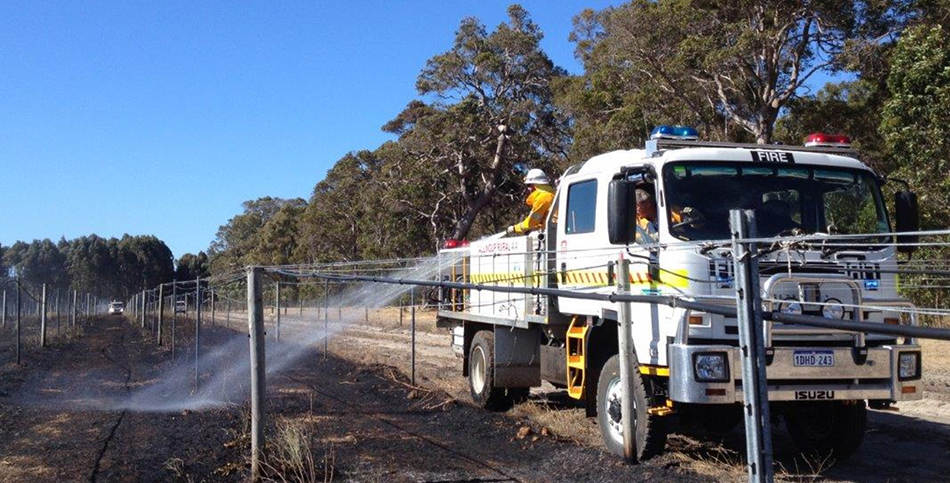
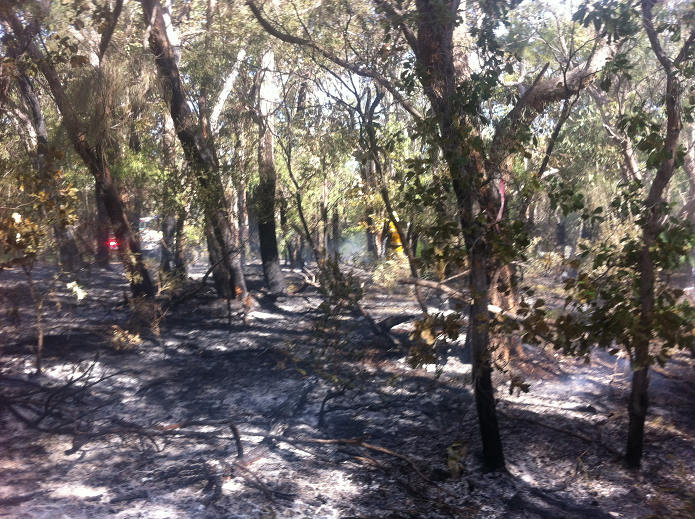
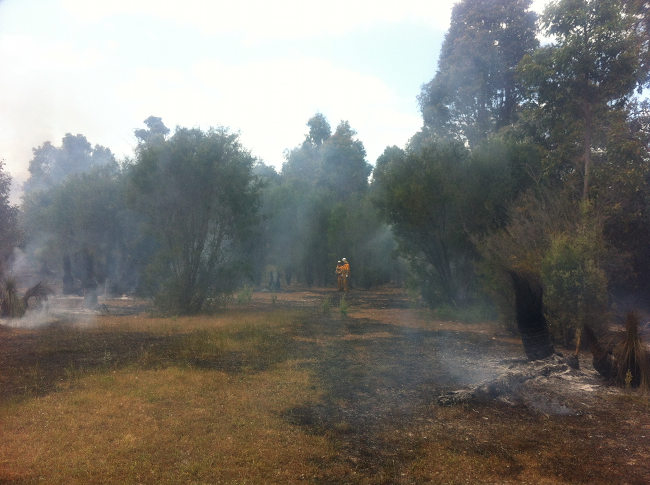
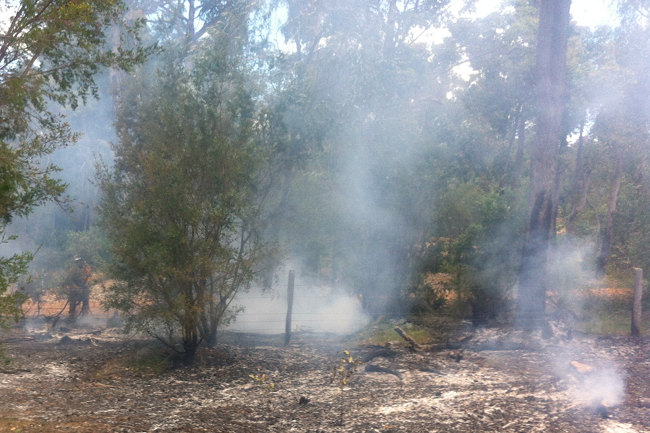
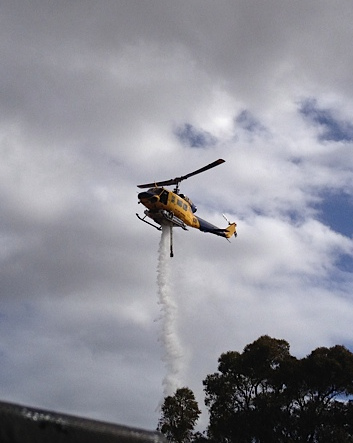
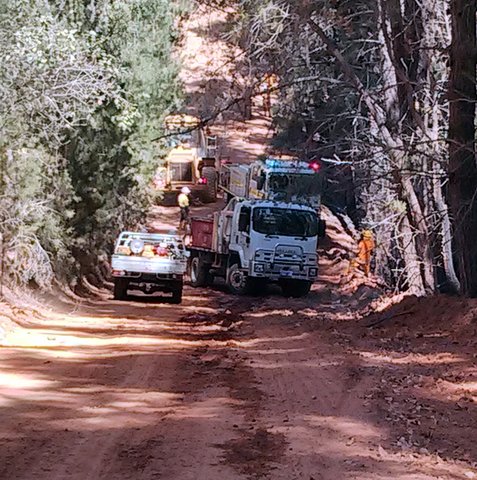
Did someone say a quiet fire season? The brigade responded to two fires in 24 hours this week. The 4.4, with a crew of five, went to the Kangaroo Gully fire, outside Bridgetown, early Tuesday and did a 12 hour shift, mainly blacking out. A lot of the work involved steep hills alongside pine plantations.
Roughly six hours later, at 1:45 Wednesday morning, the brigade was called out to a fire a lot closer to home, Kangaroo Parade. The 4.4 and 1.4 spent over two hours mainly blacking out and putting out spot fires. Andy J, Alan Y and Matty did double shifts, all day at Bridgetown and overnight in Yals.
Dunsborough and Yallingup Coastal brigades both assisted at the Kangaroo Parade fire.
Two grass fires on Sunday and Monday put an end to a new year without fires for Yallingup Rural. Both fires were out by the time the trucks arrived but they were a good reminder how lucky the district has been.
Sunday, around 13:15 a fire was reported opposite and up the road from Gunyulgup Gallery. Quick work by neighbors with portable pumps put out the fire and the 1.4 was called out to assist in blacking out the area. The fire appeared to have originated around the base of a power pole.
Monday’s fire, around 10:00, was at a farm near the southern end of North Yelverton road. Trucks from Metricup, Wilyabrup and Kaloorup attended and by the time our 4.4 arrived the fire was out. There were also handful of workers on site installing fencing who assisted in putting out the fire. Again, the brigade assisted in blacking out.
Unlike previous Christmas/New Years holidays there were no fires in the district this year. There was only one call out on Dec 30 and the light tanker got stood down half way to “the fire” at Brookland Valley. It turned out to be the notorious sea mist.
Brigade Captain Matty Muir said the double roster system worked well and thanked those members who signed up and perhaps had a more sober holiday. He especially thanked Barb for her usual great work, handling the phone over the whole period.
On the evening of Dec 28, 2012, the brigade responded to two fires, including the Margaret River Dairy Company fire outside Cowarumup. On New Year’s eve 2010 there was a fire at Indijup and in the early 2000’s there were fires on Christmas day in two consecutive years at the same location!
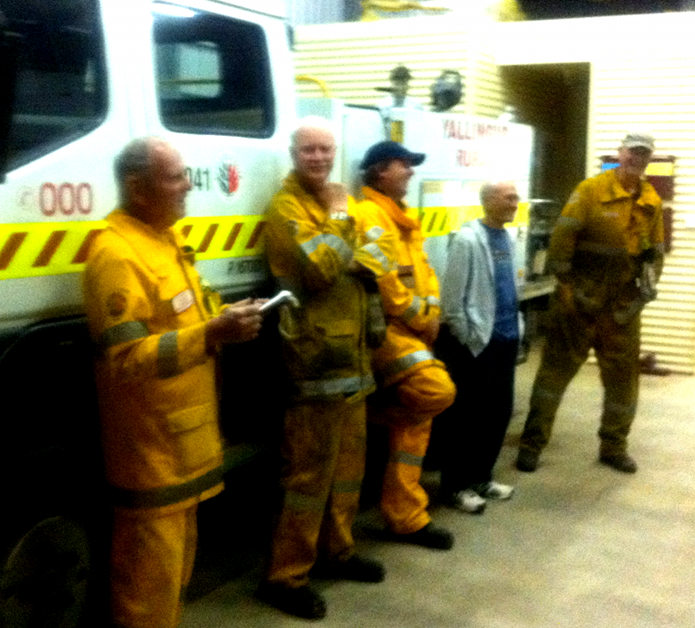
The new 12.2, 12,000 litre bulk water tanker, was christened Flo, Monday, at the brigade’s Thornton Road shed. Stevo gave a detailed rundown of the truck’s features to most of the brigade’s members.
As Yards describes it, it is an Isuzu: 2 seater; similar to the 4.4 but longer, heavier, dual rear axles, 6 speed automatic, 7.7 litre turbo charged diesel.
The PTO pump is rated at 1800 litres p.m. and the auxiliary portable pump is a Honda – 1100 litres p.m., so filling appliances is quite quick. The vehicle is for use on the blacktop, however it does have an inter-differential lock, and cross-axle diff locks at the rear, so it may be able to get itself out of trouble if some of the wheels are on the bitumen.
There is a locker on the driver’s side containing hoses, tools, branch etc, and there is a hydraulic side lifter platform on the near side to allow the collar tank and the auxiliary pump to be lowered to ground level and re-stowed. The work platform is at the rear with storage or things like fuel, rake hoes, fire extinguishers, suction hoses, road cones etc.
The collar tank can be deployed for ground support or for helicopter re-filling. It is the red “swimming pool” in the photos. The procedure would be for the collar tank to provide a supply of water for other appliances, while the 12.2 runs shuttles to keep it filled. Water is supplied to appliances (excepting possibly helicopters) by the portable pump. Alternatively, or in conjunction, appliances could be filled directly from the 12.2
There is a (small) hatch on the tank top for overhead filling. There is a Tank to Pump valve, but no Pump to Tank as on the 4.4, so if drafting is required, the portable pump needs to be used. A 25mm delivery is on the near side for a hose for verge mopping up, but there is no Monitor.
It is a two person truck and 12 people have been trained from different Busselton brigades. It will live at Thornton Road, next to the Light Tanker.
There is some debate whether Flo refers to Flo, the Hambug Damselfish in Finding Nemo, or Flo, the 1950’s Motorama V8 showcar in Disney’s Cars, or indie band Florence and the Machine. It has been suggested its theme song should be Florence and the Machine’s What the Water Gave Me.
Flo, the 12.2 water tankerThe portable water collarFilling the water collarFlo, sharing the shed with the Light Tanker
WA Emergency Services Minster Joe Francis this week said the Government will investigate introducing legislation for some volunteer firefighters which will make it easier to get workers’ compensation if they suffer certain types of cancer, the ABC reported. This followed the passage of a bill that gives these rights to career firefighters. Further information here:
The law will operate on the presumption that firefighters got certain cancers at work. Firefighters with cancer currently face a difficult task in most cases in claiming insurance, including workers compensation, because they face the requirement of identifying which chemicals, on which dates, at which incidents, might have caused their illness.
The bill did not cover volunteer or DPaW firefighters. The government indicated that extending the legislation to volunteers would probably only involve those who fought structural fires. “What you’ve got to remember is that career full-time, fire and rescue firefighters predominantly battle structural fires that are covered with toxins and carcinogens,” Francis said.
WA Nationals MP Martin Aldridge says governments need to closely investigate health impacts on volunteer and DPAW firefighters.
South Australia is debating similar legislation but it is being held up by the opposition as it wants volunteers included. The SA Government did offer to include volunteers who attend 35 structure, car and hazardous materials fire a year, in the legislation. That was rejected by the Country Fire Service, which says the threshold is too high and equates to about 3 per cent of its members. While the legislation remains in limbo, the CFS is banking on community support and looking to present a petition of 20,000 signatures to Parliament in coming weeks, the ABC reported.
In September Tasmania was the first state to pass such legislation which also covered volunteer firefighters, the Hobart Mercury reported.
Postscript: In October, 2012, the then emergency minister, Troy Buswell said the government would “amend legislation to ensure a career or volunteer firefighter who developed a prescribed cancer – one of 12 cancers as scheduled in the Commonwealth legislation – would have greatly simplified workers’ compensation considerations. “It has been established that firefighters are at an increased risk of developing certain cancers through exposure to carcinogens while performing lifesaving roles for the community,” he said.
“This legislation will provide cover for career and volunteer firefighters who predominantly undertake structural firefighting duties, and retrospectively take into account their past years of service.”
April 30 is the deadline for submitting recommendations to DFES on the new legislation that will govern the operation of emergency services, including bush fire brigades.
At a presentation in Margaret River Wednesday night, April 3, DFES managers stressed they are currently working from a “blank slate” and are looking for submissions from associations, brigades and individual members on what should be included in the new legislation to replace the three existing emergency acts. One of these, the Bush Fires Act of 1954, sets out the structure and operations of bush fire brigades. The act is available here.
The submissions will feed into the process of drafting the new legislation. The next step will be the development of a draft options paper which will be circulated for further comment. The final legislation is not expected until 2015.
DFES is interested in comments relating to anything relating to brigade operations. This could range from what powers are needed to carry out our work, to the well being of volunteers, to building protection zones.
Specifically they would like the submissions to provide the context in which issues arise; a description of the issue or challenge; and a comment, suggestion or solution. They would also like to see any positive parts of the existing legislation be highlighted.
There are forms available on the DFES volunteer portal here. For more background information and instructions on how to email your comments go here on our website.